Ask Argus
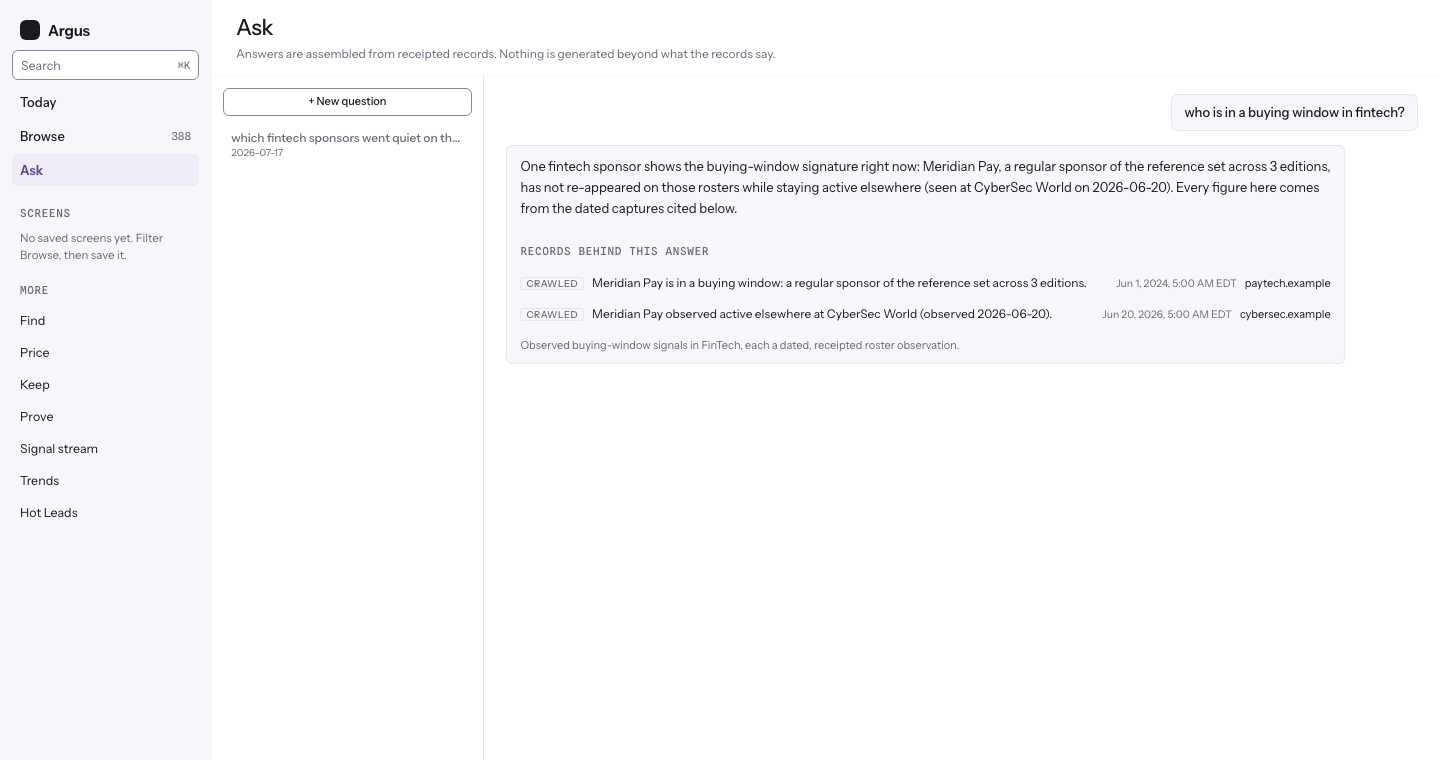
Ask a market question in plain English on the Ask page (the Ask button in the top bar, beside Search) and get an answer assembled entirely from the tracked data, with a citation on every figure. Answers read as short analyst prose, and the sources sit one click underneath, so every number in the sentence is one you can check. It is a real conversation: a follow-up like 'and in Japan?' keeps its place.
What it can answer
Ask Argus routes your question onto one of a fixed set of reads over the tracked data, and answers only from those:
- Buying window. Which regular sponsors of events like a vertical look open right now. "Which fintech sponsors went quiet on their usual events?"
- Going rate. Observed published prices for a tier in a vertical or a country, where any are on file. "What does gold cost at cybersecurity events?", or "what does a gold sponsorship cost in Singapore?". A figure that was reported in coverage rather than published on the event's own page says so in the answer and is never averaged in with the rest.
- Sponsor movement. Which events recently added, dropped, or re-tiered a sponsor. "Which fintech events lost sponsors since May?"
- Market movers. What shifted in an event's new-sponsor cohort. "What changed in SuperAI's sponsors this year?"
- Who sponsors. Which companies are currently listed as sponsors on tracked rosters in a vertical or country. "Who sponsors fintech events?" Newest observation first, one row per company, each with its dated receipt. This is present roster membership; recent changes are the sponsor-movement read.
- Events on file. Which individual events Argus tracks, in the order you ask for. "Show me the largest cybersecurity events." "What are the most recent events?" "List the events you track in Singapore." You can narrow to a vertical or country and cap the list, as in "top 5".
- Companies on file. Which companies appear across the most tracked events. "Which companies sponsor the most events?" This is a company's whole observed footprint. Who-sponsors is one slice of current roster membership.
- Coverage. How deep and fresh the tracked data is, and what kinds of events Argus tracks. "How many martech events do you track?"
Asking for an order
On the two list reads you can say largest, biggest, newest, most recent, most editions, or alphabetical. Say smallest or oldest to flip the order. Argus states the order it used in plain words at the end of the answer, so you never have to guess what your word meant.
"Largest" means the most distinct sponsors on file for that event. It counts what Argus has observed on the pages it holds. It is not a judgement about which event is better, and there is no "best" ordering anywhere in the chat. Asking which of these events is best for your own conference gets a refusal, because that is a ranking Argus does not have. The deal side is where targets get ranked.
When a list comes back empty but Argus does cover that market, the answer says so and gives the coverage numbers. A correct empty result should never read as missing data.
A who-sponsors exchange looks like this: ask "what web3 brands are sponsoring events?" and the answer lists companies observed on tracked crypto and web3 rosters, each as "on the {event} {year}roster" with the date it was seen and the page it was read from. Follow up with "and in Japan?" to narrow the same read.
Where the sources live
Under every answer is one Sources line with a count. Open it for the rows the answer was built from: each carries where the fact came from, the date it was observed, and a link to the page. It starts closed so the answer reads as an answer.
Some figures are read from hundreds of pages at once rather than from one. How many events Argus tracks is the clearest example. Those figures have no single page to link to, so they stay in the answer sentence where you are already reading them and do not appear as a source row. A source row always links somewhere; that is what makes it a source.
What it refuses, and why
Anything outside those reads is refused: predictions, opinions, companies the data cannot know, and anything about ranking targets for your own event. The refusal protects the answers you do get. Because Ask Argus can only speak from captured data, every number it gives you is one you can check. Ask about a market Argus has no vertical for and the refusal names the ten tracked verticals so you can re-aim the question.
The daily budget
Each member has a daily Ask Argus budget. Past it, answers stay fully cited but drop the prose phrasing until tomorrow (UTC). A separate daily question limit refuses further questions until midnight UTC. Both reset automatically, and repeating a question you already asked is free.
Conversations
Follow-ups carry context: after "which fintech sponsors went quiet on their usual events?" you can ask "and in Japan?" and the scope narrows. Your conversations are saved in the rail, private to you, and each answer keeps its citations.