Price: published rates
What does a sponsorship actually cost in your market? The Price page collects prices that events PUBLISHED, each captured on a date from a page you can open, and aggregates them per vertical and tier.
Where: Price in the left rail. The page opens on your own market, using the vertical you gave us at signup, so there are prices on screen before you touch anything. Switch markets with the chips at the top; whatever you pick is what the page shows you next time. Old addresses (the Pricing tab, the Trends pricing section) still work and forward here.
The order
Tiers are listed by price, most expensive at the top, so scrolling down is the descent. The order follows the price actually published rather than the tier's nominal seniority. If a market's Gold costs more than its Platinum, Gold sits higher, because that is what the rate cards say.
One thing bends the order, and it has to. Not every tier publishes in the currency you chose, and Argus never converts. Ranking an unconverted 7,500,000 above an unconverted 60,000 would be asserting a comparison between two currencies, so the descent runs inside one currency at a time: every tier priced in your currency first, in descending order, then the tiers that had to fall back to another one.
Reading a tier
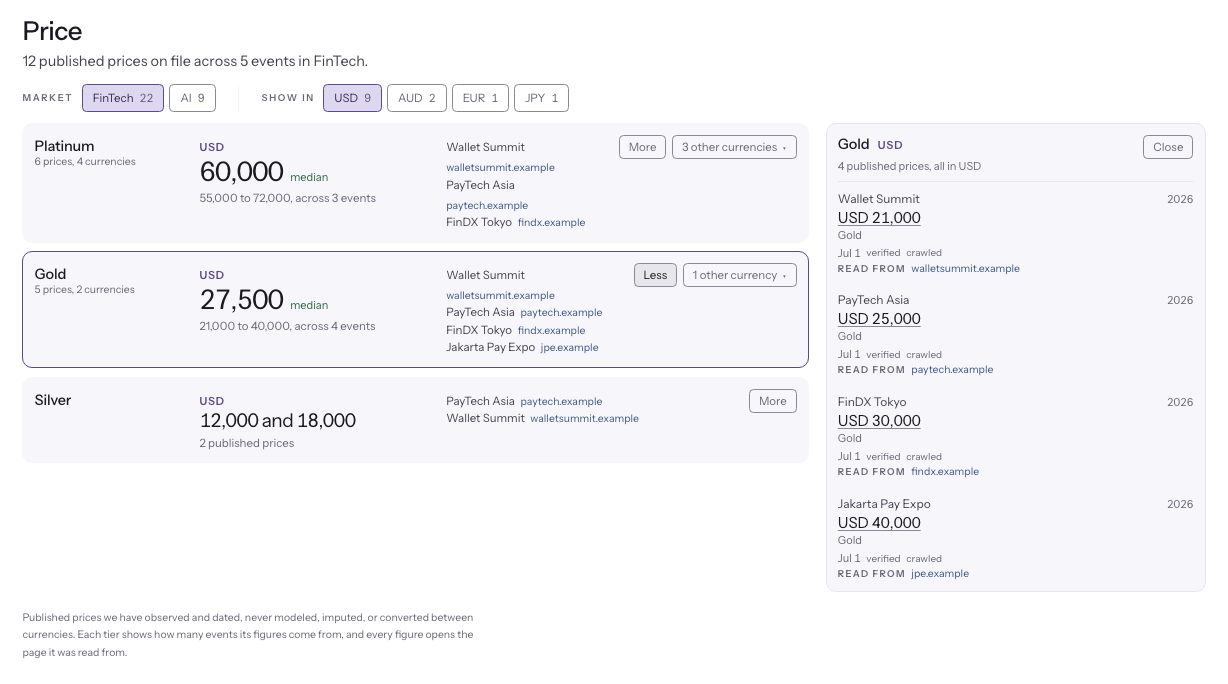
Each sponsorship tier gets its own container, and each container leads with a single currency: the one selected in "Show in" at the top. Argus never converts a price, because a converted number would be partly an exchange-rate guess rather than something an event actually printed. That is also why a tier leads with one currency rather than several at once. Four unconverted figures side by side invite exactly the comparison the rule exists to prevent.
If a tier has nothing published in your chosen currency, it falls back to the currency the most events there did price in, and says so on the row. The other currencies a tier published in are one click away under "other currencies", each keeping its own figures, its own sources, and its own record on its own line.
What a container shows depends on how much has been published, and the difference is deliberate. Where three or more events priced that tier, you get the median, the range, and how many events stand behind it. Where only one or two did, you get those actual figures instead, because a median over one number is that number and a range whose ends are the same number describes nothing. Two published prices are shown as two published prices.
The events that published each figure stay on the face of the row, each linking to its Argus page and to the page the price was read from. You do not have to open anything to see where a number came from.
"More" opens the full record beside the list, in the column the rows deliberately stop short of. It holds one block per published price: the edition, the price string exactly as printed, what it buys, the capture date, whether the quote was verified against the stored page, and the page it was read from. Opening it moves nothing, so the comparison you were making down the list survives the click. On a narrow window the record appears under the list instead.
Every currency has its own "More", including the ones inside "other currencies". This matters because a tier's USD figures and its AUD figures were published by different events on different pages, so there is no single record for a tier, only a record for a tier in a currency. The pane names both at the top, and every figure in it says which page it was read from. One record is open at a time, and opening another replaces it.
Where: prices by country
Sponsorship pricing is published far more unevenly by country than by market, so the "Where" chips scope the prices below them to one country. They appear beside "Market" whenever the corpus holds prices in more than one country, and they describe the market you have selected: switch markets and the counts on the chips change to match. "Everywhere" is the default, and it is a real answer rather than a missing one: with a corpus this thin, forcing a country pick would hide most of what is on file.
Each chip carries the count of prices behind it. Where a country also has figures that came out of coverage rather than off an event's own page, that count sits beside the first one and is kept separate, because the two are shown to you differently: the first becomes the amount on a tier, and the second is listed on its own further down.
A price is filed under the country of the event that published it. So this counts where sponsorship was sold rather than where a sponsor is based, and an event whose location we do not hold appears under "Location unknown" instead of being folded into a country it might not belong to. The sentence beneath the chips says the same thing on the page, so you never have to come here for it.
Reported in coverage
Some published figures were quoted in a news article, an organizer's own announcement or a tourism board's press release rather than printed on the event's own sponsorship page. Those appear in their own list under the tiers, marked "Press-reported", each with the date it was observed and the page it was read from. Hovering the mark names the kind of publisher: the event's own announcement, a tourism board or government agency, a trade publication we recognise, a press release wire, or coverage whose publisher we do not recognise. A market whose only prices came from coverage still gets its own chip, so nothing we captured is hidden behind an empty board.
These figures are never averaged into the amount shown for a tier, and that separation is deliberate rather than cautious. The amount on a tier is the number you would negotiate against, and a journalist's account of what a deal cost is not the same evidence as an organizer's own rate card. So a press-reported price is shown to you as exactly what it is: one dated sighting, on its own line, with its source open.
The gaps are visible
Most events do not publish their prices, so most verticals show "not on file" for most tiers. Argus leaves the gap visible rather than filling it with a model. When a price IS on file, you can open the dated capture it came from, which makes these numbers usable in a negotiation in a way an estimate is not.
The same prices on a deal row
Where a captured price matches an exact event, tier and year, it also shows on that deal row on the company page, above the estimate for the same row, with its own receipt link. It is the same captured fact this page aggregates, shown next to the deal it belongs to.