Company pages
Each company has a page: everything Argus has observed about its sponsorship behaviour, as a dated timeline with sources. Use it to answer 'what does this brand sponsor?' before you write to them.
Where: the search box at the top of the left rail finds any tracked company; the companies grain of Browse (under Market) lists them all; or click a company name anywhere in the stream or the deal grid.
Search does not offer a company it has nothing to show. A company whose every row has been set aside, or whose only rows sit on a catalogue entry that was merged away, has a page with nothing on it. Search used to suggest those companies anyway, so the honest answer to "do you track them" arrived as a link to a blank page. They are no longer suggested. Nothing is deleted and no page is removed: the profile is still reachable by its own address, and a press-reported company is never affected, because a press row serves with its badge and counts towards presence. A search suggestion is an offer to navigate rather than a claim about the market.
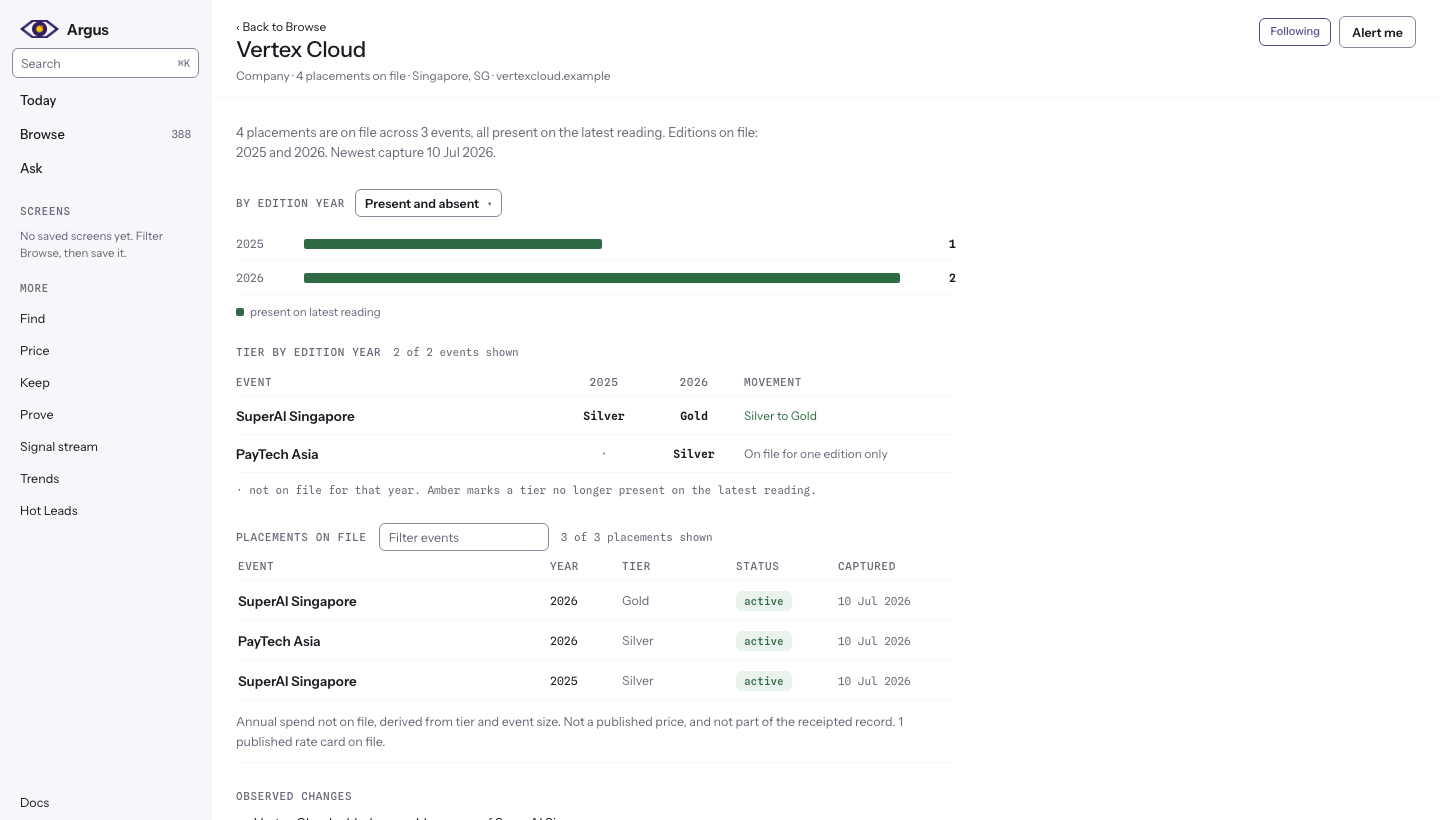
Reading the history
The page opens on one sentence: how many placements are on file, across how many events, whether they are all still present on the latest reading, which editions are on file and when the newest capture was made. A company on file for more than one edition then reads two ways. By edition year is one row per year with a bar for that year's rows; the menu beside it switches the same rows between present and absent, the tier mix, and first appearances against returns. Tier by edition year lays the company's events down the side and the years across, with the tier word in each cell, a dot where nothing is on file for that year, and the movement between the first and the last edition on the right.
Placements on file is the register underneath: which events this company appears at, in which years, in which role, with its status and capture date per row. Type in the box beside the heading to filter it (and the tier matrix with it) by event, tier word or year; eight rows show before Show all. A row opens the placement's own record, with its exact quote and source. Observed changes (added, dropped, tier moves) follow in the same dated form. Follow the company to get its new signals on your feed rail and into your alerts. Everything you follow is listed on the signal stream.
What the counts count
A company page holds every relation Argus has observed, and sponsorships are only one kind. A sponsorship, an exhibitor booth, a media partnership and a side event the company ran itself are four different things, and the same split the event pageuses applies here. So the line under the name states what is actually on file by role, for example "2 exhibitor booths on file" for a company that has only ever taken a booth. A company whose record is all sponsorships reads exactly as it always did. Each row's own Tier column says which kind that row is: a sponsor's tier as the page gave it, "Listed, no level" where the page gave none, and the role itself for a booth, a media partnership or a side event hosted.
Companies that run events
Some companies are organisers as well as buyers, and their pages carry two tabs: Organizer, listing every tracked event they run with its industry, place and dates, and Sponsorships, holding the deal history, counts and signals exactly as every company page shows them. The page opens on whichever side has more on file, so an organiser-first company opens on its events and a sponsor-first one on its record. An "Event organizer" badge sits beside the name. The two tabs never mix: running your own event is not a sponsorship and never counts towards the deal figures, while the same company can still appear in the history as a sponsor, exhibitor or partner of other people's events. Following an organiser link anywhere in Argus lands here; a separate organiser listing survives only for organisers that have no company record at all. Where the company row itself carries no website, the page shows the site its tracked events are published on, read from those events' own pages.
Why some names show two forms
A company whose name is written in Japanese, Korean, or Chinese shows an English or romanised reading first with the original in parentheses, for example "NTT Docomo Business (NTTドコモビジネス株式会社)". The original is always the company's identity; the English form is a reading aid. Where Argus cannot render a confident English form it keeps the original alone rather than guessing. Every stored English name records where it came from.
Reaching the firm
Workspaces with contact resolutionenabled see two additions on this page: the firm's outward links and a contact card. The links row carries the company's website, read from its stored domain, and its LinkedIn page where one of our licensed data vendors has supplied it. Each link states where it came from and, for vendor links, when it was observed. Argus never visits LinkedIn itself: a LinkedIn address here is data a licensed vendor delivered, shown as a link for you to open.
The Find contactbutton looks for the person who owns partnership and sponsorship decisions at the firm: partnerships, marketing and events leads first, with in-region people preferred. Company size shapes the pick where it is known: at a small firm the founder or chief executive is a fair target, while at a larger established company Argus prefers the hands-on partnerships owner over the executive suite, and the "why this person" line says so when that preference decided the order. It checks the cheapest sources first: contacts already on file, people the company publishes on its own website, then the licensed vendors, in rising cost order. A found contact shows their name, title, work email where one exists, their LinkedIn profile, and where the record came from. Contacts are cached for your whole workspace, so a colleague opening the same company later sees the same card at no further cost.
You can also tell Argus who you needin one sentence, for example "the person who signs off on sponsoring fintech events in Southeast Asia". Type it into the intent line on the contact card for one lookup, or save it once as your workspace's standing description (Argus asks for it the first time, and you can change it any time). Contacts are then ranked against your description, and each one carries a short "why this person" line built from its own recorded facts: the title, the region, and whether the title's own territory matches yours. A person outside your territory is still shown, labelled as the closest on file, never silently promoted. A sentence Argus cannot understand is said so plainly, and the standard profile applies.
Small badges say where each record came from: staff-verified is an entry the Ducket team added by hand with an evidence link; company site is a person named on the firm's own website, shown with the page it was read from; derived + verifiedis an email address built from the firm's observed address pattern and confirmed by a verification service before it was allowed to appear. An unverified guess is never shown at all.
The fee column
The fee column shows a published price when Argus has captured one for that exact event, tier and year: the figure as the organiser printed it, in the currency they printed it in, with a receipt link to the dated page it was read from. Under it, in faint text, sits the estimate for the same row so you can see both.
Where no published price is on file, the column shows the estimate alone, derived from tier and event size and labelled as an estimate. The two are never blended into one number, and a published price in another currency is never converted. The header strip counts how many of a company's current sponsorships have a published rate card on file. That count is deliberately not a total: prices arrive in whatever currency the organiser used, so adding them up would invent a figure. The estimated annual spend beside it stays a pure estimate and never borrows from an observed price. Bands across events live on the Price page.