Coverage
Coverage answers one question: how deep is Argus in the market you care about? Read it before you rely on any other screen, because every count in Argus is only as good as the coverage behind it.
Where: the receipt line under any answer says how many tracked events the claim rests on; that count links here. The direct address is /feed/coverage. The board left the rail on purpose: the answer to "should I believe this number?" now sits beside the number it qualifies.
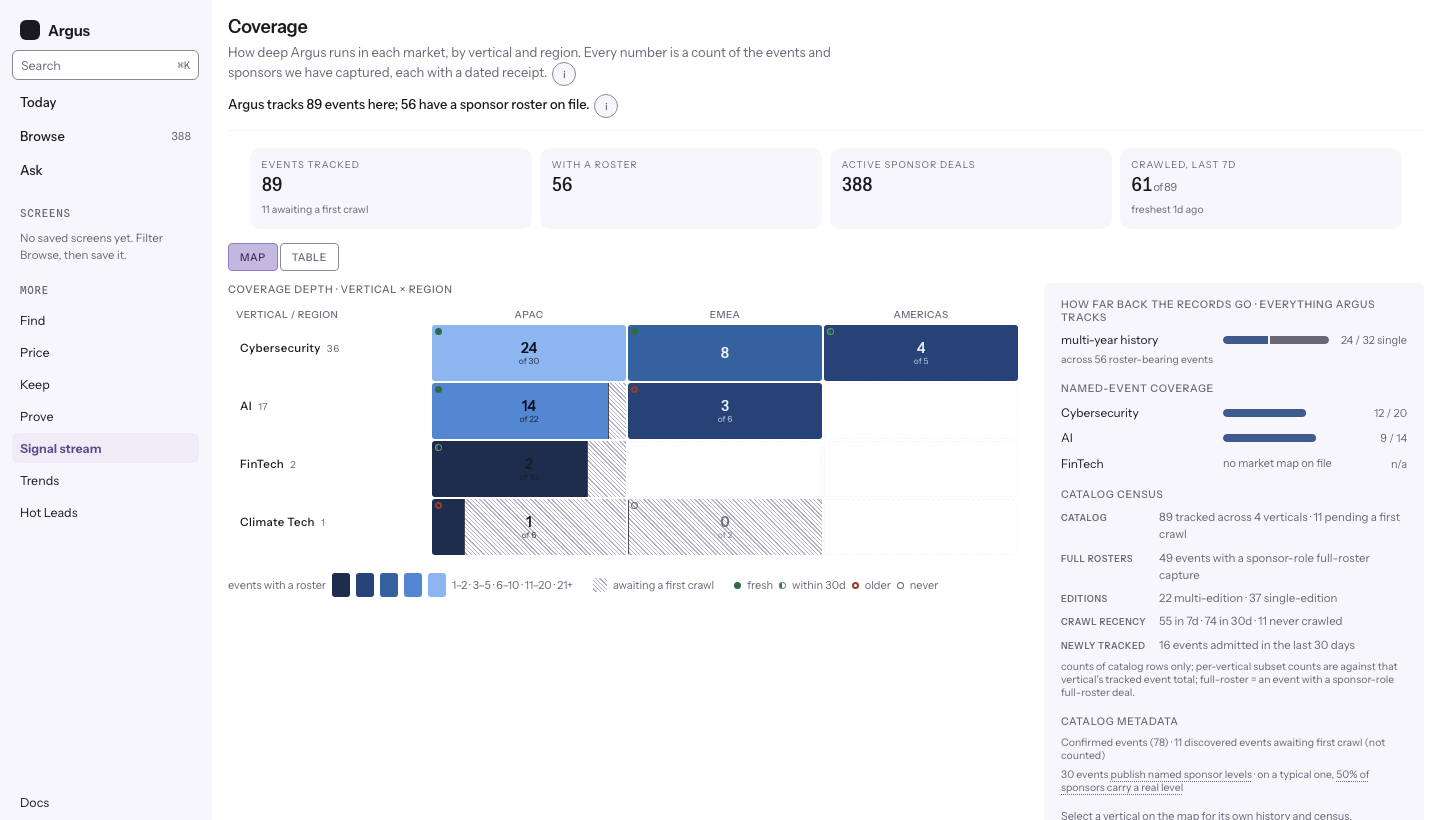
The figures, defined
- Events tracked. How many events Argus is watching in a slice. Some are freshly discovered and await their first crawl; those are counted separately.
- With a roster. How many tracked events have at least one captured sponsor on file. This is the number the map's colour reflects, because it is the honest measure of held data rather than known names.
- Active sponsor deals. The count of captured sponsor-to-event links currently on file.
- Crawled in the last 7 days. A freshness reading: of the tracked events, how many were re-checked this week.
Reading the map
The big number in each cell is the roster-bearing count; a smaller "of N" shows the tracked total when they differ. A hatched band marks the share of events still awaiting a first crawl. An empty dashed tile means that pairing is untracked, which is an absence rather than a zero. Each cell also shows how fresh its last crawl is, in shape as well as colour.
The per-vertical drill
Selecting a vertical opens its census: events by status, how many editions of history each event holds, freshness buckets, and recent additions. The multi-edition split matters most; movement reads such as drops and returns need more than one edition of the same event on file.
Requesting a missing event
If a conference you care about is untracked, submit it from this page with its website. Requests join the tracking queue and are picked up on the next operator pass, and the page shows the status of what you asked for, from requested through tracked.