Event pages
Each tracked conference has a page: its sponsor roster per edition, what changed between editions, the audience numbers it published, and the crawl history behind all of it. This is where you research a specific event before a pitch.
Where: the search box at the top of the left rail finds any tracked event; the events grain of Browse (under Market) lists them all; or click an event name anywhere in the stream or the deal grid.
What search matches. An event's own name, any other name it is published under, and the organiser stated on its page. So typing an organiser finds their whole portfolio on file, even where none of the event names carry the organiser's name: type Clutch Events and you get the Sydney and Melbourne summits they run. A result whose own name does not contain what you typed says on the row which name or organiser it matched, so a hit you did not expect explains itself. The Browse search box matches the same three things, on the deal grid.
Editions: the rows, the matrix and the roster
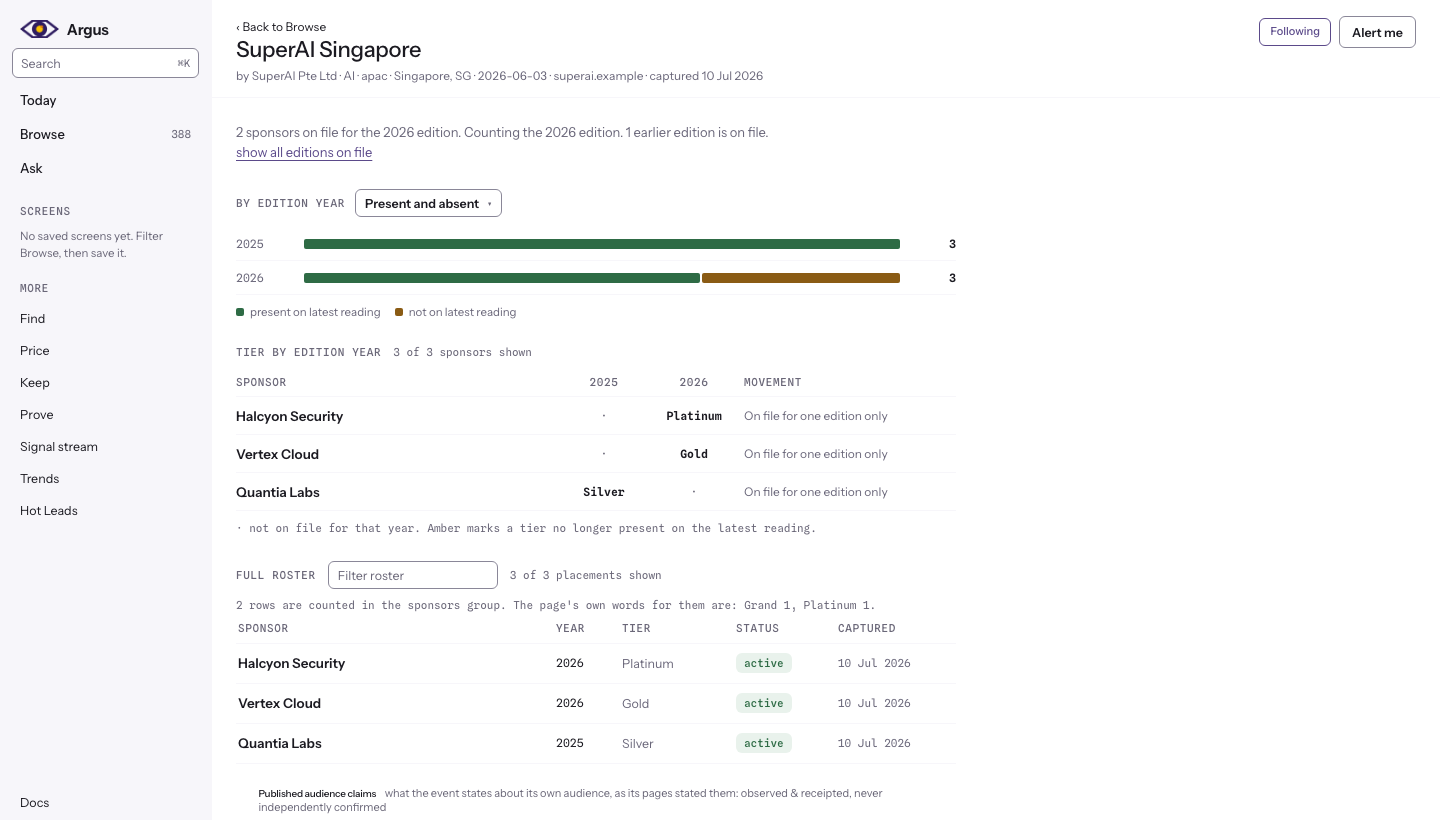
The page opens on one sentence: what is on file for the edition being read (sponsors, exhibitors, media partners, side event hosts), how many of those rows are no longer present on the latest reading, and which other editions are on file. An event on file for more than one edition then reads two ways. By edition year is one row per year with a bar for that year's rows; the menu beside it switches the same rows between present and absent, the tier mix, and first appearances against returns. Tier by edition year lays the sponsors down the side and the years across, with the tier word in each cell and, on the right, the movement between the first and the last edition on file:
- A tier word in a cell is what that edition's page called the company, exactly as it was captured.
- A dot is a year with nothing on file for that company. It is a gap in the record, and never read as the company leaving.
- The movement names a tier move ("Silver to Gold"), a tier held ("Same tier both editions"), or, in amber, a company whose own latest row is no longer present on the latest reading. Only a recorded absence reads that way; a missing year never does.
Full roster is the register underneath: every company on file, newest edition first, with its year, its tier word (or its role, for a booth, a media partnership or a side event hosted), its status and its capture date. Type in the box beside the heading to filter it (and the matrix with it) by company, tier word or year; eight rows show before Show all. A row opens the company's own page, where each placement opens its record with the exact quote and the page it was read from.
A captured roster means at least three companies. A single company on file used to be enough to call an edition captured, and that produced a confidently wrong answer: an edition known from two names picked off a homepage would be compared against a full 138-company roster, and all 138 would read as new. Below three companies an edition now says "not enough coverage to compare". Nothing is deleted. Those companies keep their rows, their dated source pages and their receipts, and they still read as cited mentions of that edition. The floor came from measuring the corpus: rosters of one and two behave like scraps of page furniture, real rosters start at four, and three is the boundary, kept rather than dropped, because where the evidence is ambiguous Argus keeps the record and declines the conclusion. A registration, ticketing or checkout page is never read as a roster at any size. A conference homepage still is, since a homepage logo wall is a real roster.
Some pages are never read as a roster. Before a page is read for sponsors, Argus checks that it is a page a person could have visited and that it belongs to the event. An XML sitemap, a robots file and an RSS feed are machine files rather than rosters, and they are refused outright. So is a link shortener and a listings site republishing someone else's page, because neither can be cited as the event's own record. A long article that merely mentions company names is refused too. That rule applies to every page read from now on. Rows captured from such pages BEFORE the rule existed are still on file and still counted, and they are being retired in batches. Nothing is deleted: once a row is retired it keeps its date and its source, its receipt says in plain words which rule refused the page, and from that point it stops counting on any roster and stops counting towards another company being absent. Where a shortened link can be followed to the real page, the row is re-pointed at that page instead of being retired, and its receipt keeps the old shortened link so nothing about the row's history is lost.
A row can also be retired because the page never named it. Argus keeps the exact copy of every page it reads, matched to that reading by a checksum. When a row is re-checked against its own saved copy and the company is not in it anywhere, the row is retired: it keeps its date, its source and a receipt saying what was checked, and it stops counting on any roster. That check is only trusted when the saved copy provably matches the reading it came from. A re-check that could not find the right saved copy says exactly that, and a row is never retired on it, because "could not check" is not the same as "was not there".
The same re-check now also retires rows the page listed as something other than a sponsor. A speaker's employer, a person's name from a leaders wall, or the company running a side event can be read off a page that never called any of them a sponsor. When the saved copy confirms that reading, the row is set aside the same way: kept, dated, with its receipt saying why. It stops counting on the roster and in alerts. One exception is deliberate: where the page itself printed a real sponsorship label next to the name ("Gold Sponsor"), the page's own words win and the row keeps serving.
A page that says "more pages" is never treated as the whole list. Some exhibitor directories run to hundreds of entries across many pages, and a capture of page one used to be stored exactly like a complete roster, which then let "not on page one" read as "not there". When a page itself shows a next-page link, a "showing 46 of 323" counter or a load-more button, every company captured still counts as present, and the capture is simply never used as evidence that anyone else was absent. The receipt on such a row says so in plain words.
A drop is only ever concluded from the same page, read twice. The worst kind of false alarm is a sponsor reported as "dropped" because two different pages were compared. A homepage and a sponsors page list different companies for reasons that have nothing to do with anyone leaving. Argus now refuses that comparison outright: a roster is only diffed against an earlier capture of the same page, and when an event's tracked page changes, the first capture of the new page starts a fresh baseline instead of manufacturing departures.
A roster read off a sister event's page is set aside too. Argus fills in an event's history by fetching old copies of its pages from a web archive. Where the event lives on its own address that fetch is exact. Where it lives on one path of a much larger site, the range asked for can be wider than the event, and the archive answers with a neighbour: one conference's 2021 to 2025 rosters were read off the technology news portal the event is a section of, so the portal's own coverage became that conference's sponsor list. Those rows are now set aside from every roster surface, and the receipt says why in the same words as the coverage board: the page it was cited from belongs to a different event on the same website. Nothing is deleted. Each row keeps its date, its page and its quote. The part you cannot see mattered more: rows like that had been counted as full rosters, so they could stand as evidence that some other company was absent from an event it was never listed at. That count is zero now, and the archive fetch is refused in advance unless it can aim at the event itself.
Some entries turn out not to be events at all. A news headline, a scraped document or a listings-site shell for an event already tracked properly can end up in the catalog as its own entry. Those are retired too: the entry stops appearing in search, in Browse and as a page of its own, and where the shell was a variant name of a real event, that name is recorded against the real event so searching for it finds the right one. The entry, its rows and every receipt stay on file. Company pages still show those rows with the entry they were captured under, because a dated sighting is a dated sighting.
A page about an event is not the event. A page published by a sponsor, a booth supplier or a listings site, about somebody else's conference, is kept as a source and never taken as the conference itself. Two things have to be true of it at once before Argus treats it that way: it sits on a domain belonging to a company Argus already holds, and its own web address names a conference that a different site is already on file as running. Both are needed, because a company that runs its own conference publishes it on its own domain, and the only thing that separates the two cases is whether the event already has a home somewhere else. The page still shows as where the information came from. It is simply never used as the conference's own address, never crawled as its roster, and where the conference is already tracked, what the page says joins the entry that already exists rather than starting a second one.
Beyond the known bad shapes, an entry now has to earn its place. Every new catalogue entry records the basis on which its address is believed to be the event's own: the address itself corroborates the event's name, it sits on a platform where each event has its own declared address shape, or a person admitted it deliberately. An entry with none of those does not appear in search, Browse or as a page, and its address is not crawled as a roster; it waits for review instead. A blog guide, a booth supplier's page or an association's member listing can name a real conference and still fail that bar, which is the point: naming an event is not speaking for it. Where an address clears the bar on its name alone, the page itself gets one more reading on its first capture, and a page that describes the event rather than being the event is sent back for review. Rows captured under an entry that later fails the bar stay on file with their receipts; they simply stop standing as the event's roster.
Press coverage is treated differently, and it is labelled. A news story, an organiser's own newsroom post, a tourism board announcement and a press release are not sponsor rosters, so nothing is ever read off them as a roster. They are still real, dated, published evidence, so a company named in one is listed with a Press-reported badge instead of being hidden. The board says how many of the rows you are looking at are press-reported, and the receipt names the kind of source: the event's own announcement, a tourism board or government agency, a trade publication Argus recognises, a press release wire, or press coverage from a publisher it does not recognise. A press-reported row counts towards who was present. It never counts as evidence that another company was absent, because an article names some sponsors and never the whole list, and it is never presented as the event's own roster listing.
Events related to this one
An event can be related to another in two ways, and Argus keeps both. Some events sit inside a bigger one: a conference week publishes a schedule of other people's events, and Argus keeps the page that said so. Others share an organiser: the same company runs several shows, and each show's own page says so. Where either relation is on file, a card under the headline numbers names the family and opens it.
The family page keeps the two apart, under their own headings, so you always know which claim you are reading: Part of and Side events for the ones a programme page listed together, and Also by an organiser for the ones that share who runs them. Each heading carries the date the page behind it was read. Every related event is listed with its own sponsor count, its own dropped count, and how many of its companies are on that event and no other in the family.
Then two lists of companies, and the second is usually the more useful one. Companies on more than one event in this family names the overlap, with the wording each was published under. Only on one of these events names the opposite: who is backing one of these shows and none of the others. If you sell one event in a family, that second list is the set of companies already spending in your family and not yet with you.
Who runs the event
The organiser is printed beside the dates, and the name is always a link. Where the organiser is itself a company Argus knows, the link lands on that company's page, whose Organizer tab lists every event they run; an organiser with no company record gets a plain family listing instead. Where Argus tracks more than one event by the same organiser, the count beside the name expands in place: click it and the other events appear as links right there, one line per organiser the page named, with the full list one more click away. The listing shows each event's industry, place and dates, and the same "already happened" chip they carry everywhere else. It is a count of what Argus holds, in alphabetical order, never a ranking, and never a claim that the organiser runs nothing else. A co-organised event (one whose page states two organisers) appears in each organiser's list, and from its own page it now reaches both of them: the strip shows one line per organiser named on the page, so an event run jointly by two companies opens onto everything either of them runs. Matching tolerates a trailing legal form on the other side, so an entry stating "Clutch Events" groups with one stating "Clutch Events Limited". It does not work both ways round: an entry stating the longer legal name is keyed on that exact name, so it lists only entries that state it the same way, and its siblings appear in the "More from" strip below instead. An event whose entry never states an organiser shows no link and no list, because there is nothing on file to show.
Argus sometimes holds more than one catalogue entry for one conference: the event's own site, plus a listing site that publishes the same event. Those entries are folded into one, and the organiser reads across the whole of it. Where the event's own page never printed an organiser and a folded listing did, the name now shows, with which entry stated it, that entry's own source page and the date Argus first read that entry. That receipt is not always the page the name itself was read off: where the name was filled in later by reading the event's own home page, Argus does not store that page against the name, so it shows the entry instead. The event's own page still wins whenever it states one. Where no entry states an organiser, the event still shows no name and no list. One event appears in one place: the "More from" strip below leaves out anything already named in the organiser list.
Some event brands publish every city edition on one site without ever stating an organiser on the page. Where other tracked events share the event's own site, a "More from" strip names them, labelled with the site itself. That strip claims exactly what is on file, that the events are published on the same site, and never invents an organiser name the pages did not state.
The same rule covers the roster itself. An edition whose only evidence is partial mentions (a post-event recap page, a news article) is never presented as a captured roster. The mentions stay dated and receipted on the roster with their year; the by-edition-year rows mark such a year with an asterisk, and the note under them names the years it applies to and says that a starred row cannot be read against an unstarred one as growth or decline, only as a difference in what Argus captured. If no year on file has a captured roster, the note says that instead: those rows describe the capture, never the sponsor count.
When an event's captured rosters include exhibitor or media rows alongside its sponsors, the by-edition-year rows say so in a note beneath them: they count every captured commercial role, while the opening sentence counts each role separately. A roster that is all sponsors shows no note, because there is nothing to qualify.
When an event has already happened
An event page shows the dates on file, and beside them a chip that says what those dates mean today. "Already happened" appears once the end date has passed, and "Happening now" while today falls inside the dates. The same chip appears wherever else the event is listed: the events index, the search picker, and the side events table. An event that is still ahead carries no chip, because that is what a listing already reads as.
The chip comes from the dates themselves. Whether Argus is still checking the site has no bearing on it. A finished event keeps its page, its roster and its receipts, and that roster is often the most useful thing on it, because it is a complete record of who backed that edition rather than a list still filling up.
Who counts as a sponsor
A roster is split by what the page actually calls each company, because these are different products and reading them as one number would overstate every event:
- Sponsor roster. Companies backing the event, at whatever level the page names.
- Exhibitors. A booth is bought separately from a sponsorship, so exhibitors are never priced with the sponsorship estimate.
- Media partners. Usually barter rather than cash.
- Side-event hosts. Companies the page credits with runningtheir own event here, typically with the word "Organizer" on a side-event card. They are the opposite side of the trade: a host sells its own event's sponsorships rather than buying this one's. They are never counted as sponsors, never priced, and never appear in a year-over-year sponsor comparison.
Workspaces with contact resolution enabled also see two small links on each roster row, to the company's website and its LinkedIn page where those are on file, so you can move from a name on a roster to the firm itself without leaving the page. The company page is where the contact card and the find-contact button live.
The headline "Active sponsors" number is the sponsor group only. The other groups are listed under it and get their own sections further down the page.
The page's own words for the tiers. The Tiers figure folds each page's labels onto one ranked ladder so rosters can be compared: Singapore Fintech Festival's top level is literally called "Grand", Money20/20's is "5 Star Sponsor", and both count as the top rung. A line under the numbers quotes the page's own words and how many rows carry each, and every roster row shows the verbatim label in its "As listed" column, so nothing the organiser actually wrote is hidden behind the fold.
Which edition the board is showing
An event page counts one edition at a time, and says which one in the same sentence as the numbers. That edition is the event's own year when Argus holds a roster for it, and otherwise the most recent year on file, which is why a 2026 event with nothing captured for 2026 yet will tell you it is showing you 2024.
The opening sentence names the other editions on file and links to the all-editions view, so you can count the whole record in one place when you want to. That view is labelled too: a tier counted there may belong to any edition, which is exactly why it is not the default. Every edition's rows are always in the roster, each with its year, and in the tier matrix, each under its year.
An edition whose every row was set aside keeps its place, at zero. A year used to disappear from the sponsor chart and from the edition list when every row Argus held for it had been set aside, while a year that was merely thin kept its place and earned a note. That was the harsher treatment of the weaker case, and it read as though the event had not happened. Those years stay now, with a bar at zero, a count of how many rows are being held back, and a sentence saying the bar stands at zero because every row for that year was set aside with the reason recorded against it, never because the event had no sponsors. Nothing enters a count: a held-back year is still not a captured roster, so it cannot be compared against another edition, and a starred bar still reads as a difference in what Argus captured rather than as growth or decline.
Long rosters, and each company once
A large expo roster runs to hundreds of rows, so each group shows its first 50 with a "Show more" control under it. The count line beside the heading states how many are displayed and how many are on file, and the order never changes when you reveal more.
Where two catalog entries for the same event have been linked as one series, both were crawled, so the same company can have been seen twice for one edition. The roster shows it once, and the event's own page wins: a sighting from the event's own site beats a newer sighting from a news site or an events directory, so when TOKEN2049's own partners page says Gold and a directory says Platinum, you read Gold. Among sightings from the event's own site, the most recent wins; where no own-site sighting exists, the most recent sighting wins exactly as before. The shown row keeps that capture's own date and its own verification state: a newer capture that failed a check is shown as needing a check rather than inheriting the older capture's verified mark. A company listed in two different roles for one edition, a sponsor and an exhibitor, keeps both rows, because those are two things it bought and not a duplicate.
When a previous edition is on file
Some event pages carry no current roster yet, or only a thin early one, but Argus holds the companies that backed the last edition, either from the page's own "previous sponsors" heading or from a dated earlier capture. Argus never counts those companies as the current roster, and it used to keep them behind the all-editions toggle, which read as though the event had little sponsor history worth knowing. Now they show in their own section, labelled "Previous edition sponsors", under whatever current board exists, each with the page's own word for them and the dated capture it came from. A company already on the current board never appears again in this section, so nothing is listed twice.
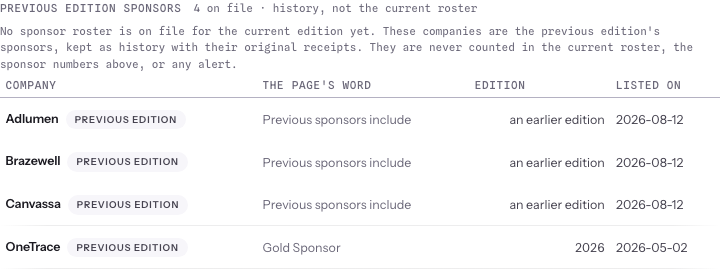
- Never counted. A previous-edition row enters no sponsor number, no chart, no comparison, and no alert. It is history with a receipt.
- Never priced. No fee estimate is shown for a previous-edition row.
- The edition column is honest. When the page said "previous" without naming the year, the row says "an earlier edition" rather than inventing one. A row from a dated earlier capture names its year.
- The section shrinks as the current roster grows. Each company that lands on the current board leaves this section the same moment, so between the two lists you always see each company once, and the freshest thing known about it.
Event weeks and their side events
Some entries in the catalog are not single conferences but weeks: ETHTokyo Week, Token2049 and the like publish a schedule of other people's events. Those pages are marked event week, and a Side eventstable lists what the week's own page advertised, with the date it was listed and a link to the page that listed it. Each side event has its own page in the catalog, and that page says which week it belongs to.
Published audience numbers
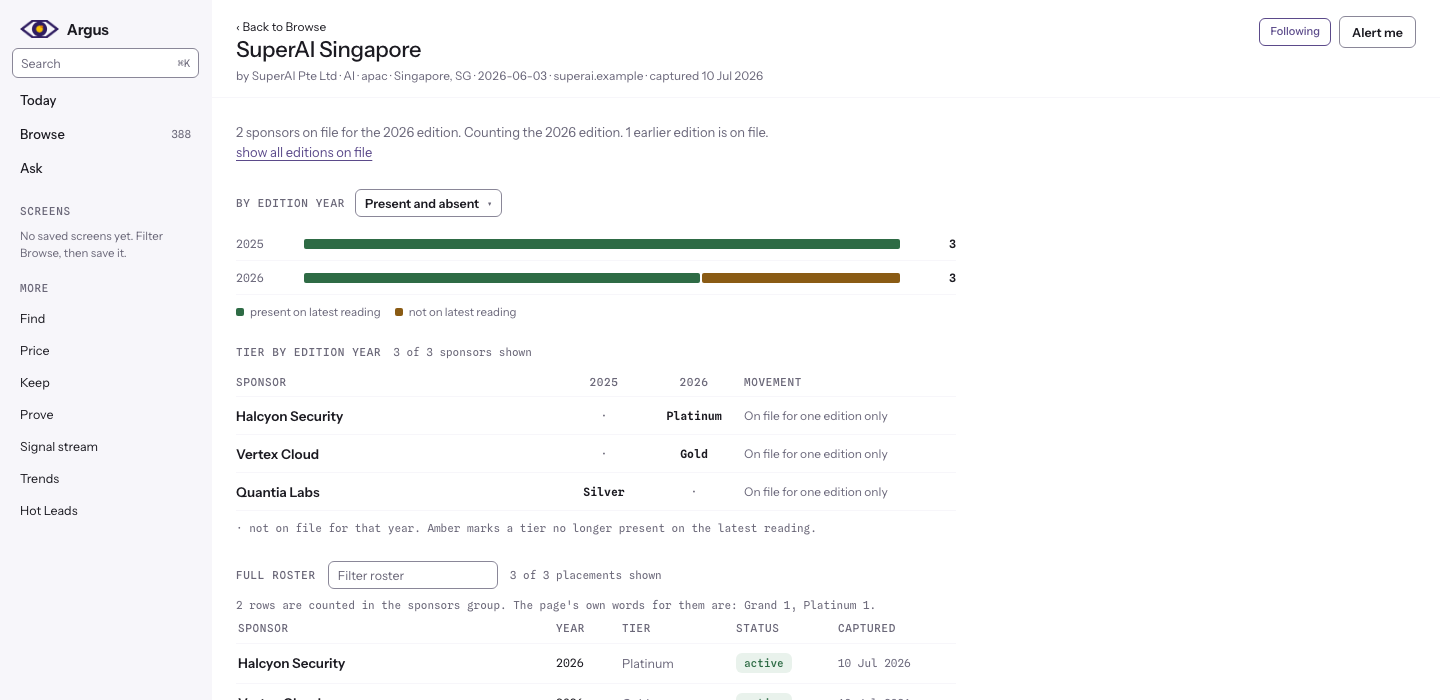
The claims panel collects the audience figures the event itself published: attendees, exhibitors, speakers, sponsors. Each shows the parsed figure first (for example "500+") with the exact published text beside it, whatever language it was written in, and a link to the dated capture. Where figures for the same metric differ across editions or within one edition, the panel shows both with both receipts.
A figure is compared across editions only when the page said which edition it was. Argus takes the edition a captured page describes from the page's own statement: its web address, its title, or the heading above the figures. It used to accept a much weaker signal as well, the year appearing most often in the body text, which is how a page saying "founded in 2014" could date its figures to 2014. That signal no longer counts as the page naming its own edition. Some figures that used to be compared across editions now read as undatable, and on a few events there is nothing left to compare at all: the panel then shows the figures with their receipts and says nothing about agreement, which is the honest answer rather than a comparison it cannot support. No stored figure was re-dated. Re-writing an observation to fit a better rule is the move Argus refuses.
Crawl history
The crawl panel shows when Argus read the event's pages, what each read yielded, and stored page screenshots where available. If a capture went wrong, the row says how. This is the raw provenance layer; when a number upstairs surprises you, this is where you check what it rests on.
Grouped editions
Conferences rename across years, and an edition sometimes enters the catalogue under a drifted name. The Ducket team links such duplicates into one series after review, and the event page then shows the combined history. Nothing merges automatically.
A full rebrand is the same link on stricter evidence. When an event starts publishing under a new name, its old entry stops updating and the new brand arrives as a separate entry, so the record would otherwise read as a mass sponsor exodus on one side and a brand with no history on the other. Argus links the two only on a dated page from the event's own site that names the old name and the new one together, and it keeps that quote as the receipt. Coverage published under either name then reaches the same event, and the roster history reads as one series. Until that page is on file, Argus stops concluding anything from a page whose title no longer names the event: no drop, no new sponsor, nothing added to the roster from it. A page that no longer names the event cannot speak for it in either direction.